
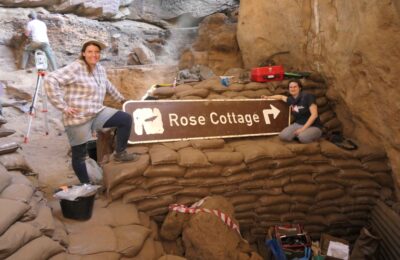
Rose Cottage Cave
Time for essential changes The Middle Stone Age (MSA) in South Africa during Marine Isotope Stage (MIS) 5 marks a crucial phase in human cultural evolution. Using a broad methodological repertoire, the sites Bushman Rock Shelter, Rose Cottage Cave and Sibhudu Cave are investigated to draw conclusions about technology, techno-economy and land use as well as the emergence of innovations and group networking. The MSA of MIS 5, dated to approximately 130,000 to 75,000 years ago, is characterized by the emergence of new behaviors typical of modern hunter-gatherer societies and regionally distinct technological traditions, manifesting significant changes in human cultural evolution. Although for a long time there was a lack of scientific attention and only certain regions were studied in this regard, the focus of research has increased significantly, especially in the last decade, and more and more evidence is being presented that underlines the unique, inventive and creative character of this period. Increasing data from archaeology, paleoanthropology, paleogenetics and paleoclimatology point to a complex mosaic scenario of small-scale structured and widely interconnected populations within Africa during the MSA, which successively gave rise to cognitively modern humans with specific cultural characteristics. MIS 5 appears to be the period in which new ideas were tested and behavioural complexity emerged due to various internal and external circumstances before being consolidated in the…