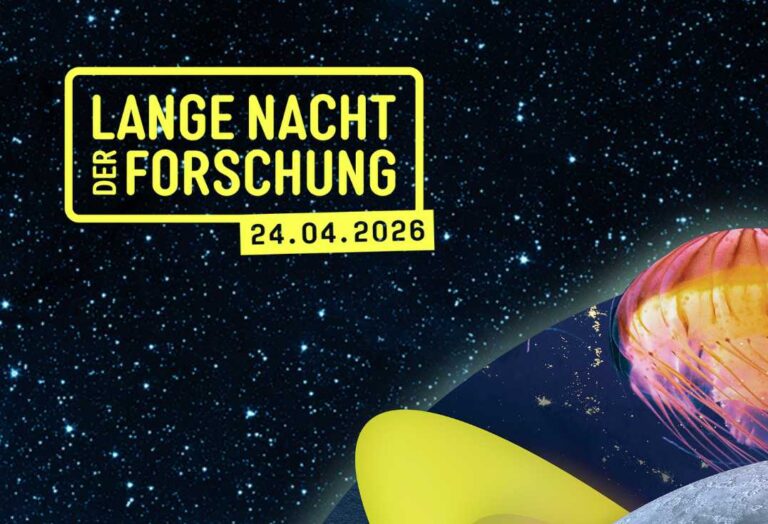
Lange Nacht der Forschung 2026
More On Article
- Fire, temperature control, and silcrete heat treatment at Diepkloof and Mertenhof Rock Shelters, West Coast, South Africa
- Gerhard Weber and Harald Wilfing Retire
- HEAS Workshop in New Methodologies and Perspectives in Palaeolithic Archaeofauna takes place in Vienna.
- The gene-regulatory evolution of the human skeleton
- Demographic history and management practices shape the genomic landscape of New Zealand’s feral Kaimanawa Horses.
As a postdoc at the Department of Evolutionary Anthropology, I usually spend my days in relatively quiet labs or in front of the computer trying to decipher questions in human evolution and archaeological science. But last Friday, I traded my lab coat for a microphone (or rather a voice recorder on my phone) and headed out into the vibrant chaos of the Lange Nacht der Forschung (Long Night of Research) in Vienna. There were many stations representing researchers and themes from HEAS, and I wanted to see what type of outreach and attention they get. From the modern halls of the University Biology Building (UBB), to the historic buildings of the Academy of Sciences and the University Main Building, I caught up with colleagues who were busy translating complex science into hands-on puzzles, and explanations for thousands of curious visitors.
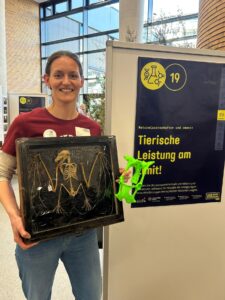
My first stop was visiting Dr Nicole Grunstra’s station at the UBB. Her research tackles a classic ‘human’ problem: why is birth so difficult for us? The traditional view is that humans are uniquely cursed with difficult births because of our big brains and narrow pelvises. But Nicole’s station, complete with 3D-printed pelvises and tiny animal skulls, tells a different story. Many precocial species (i.e., animals whose young stand up shortly after birth, like cows, deer, and zebras) also face a very tight fit. Probably the biggest surprise was bats; while a human baby is about 5-6% of the mother’s body mass, some bat pups are a staggering 45%. ‘Bats have an open pelvis as an obstetric adaptation,’ Nicole explained. ‘Natural selection is acting strongly there. In humans, modern medicine lets us intervene, but the biological trade-offs remain’.
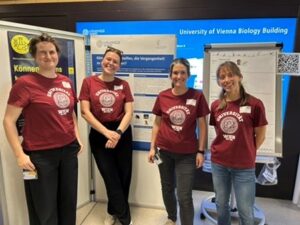
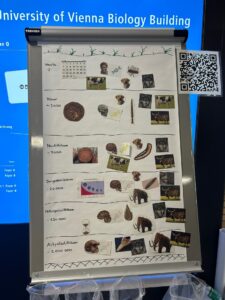
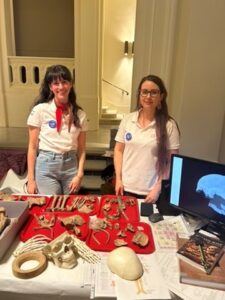
Another corner of the UBB, I found Ass. Prof. Mareike Stahlschmidt, Dr Olivia Cheronet, Dr Petra Šimková, and Dr Laura van der Sluis surrounded by a sea of skulls and evolution puzzles. Their station was a hit with the younger crowd. Petra showed off real human bones – one healthy and one with pathology. ‘The kids don’t believe me at first,’ she laughed. ‘They keep asking, ‘Is this really real?’’. Meanwhile, Laura had visitors reconstructing the past by categorising dating methods, tools, and DNA across time periods, from the Roman era back to the Lower Palaeolithic. It looked really hard for the general population – but with a few poster hints, even the 6 year olds were successfully sorting Neanderthals from Neolithic farmers. At this station there was a total mix of people, from archaeologists who had worked in Sudan to elderly couples and curious neighbours from the Vienna BioCenter.
Over at the Academy of Sciences, Dr Caroline Partiot was walking visitors through the biological profile of skeletons. ‘When we find human remains in the field (like those recently excavated from Burgenland), the work is just beginning’, explains Caroline. ‘By looking at bones with the naked eye, anthropologists can determine the age-at-death, the biological sex, and different pathologies’. There were no puzzles here, but ‘Oscar’ the skeleton was at the door to welcome everyone and the kids were thrilled to get their hands on plastic models of the remains and to see the real bones collected from excavations.
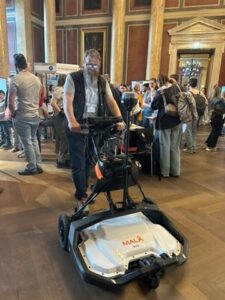
Finally, I visited Assoc. Prof Immo Trinks at the University Main Building, and let me tell you, this station had the most impressive tech. He showed me a multichannel Ground Penetrating Radar (GPR). Unlike old systems where you walk a single line, this beast measures 10 lines simultaneously with 8 mm precision. But the most urgent story Immo shared wasn’t about land – it was about water. Invasive mussels from the Black Sea are taking over Austrian lakes (like Attersee and Mondsee). They cover 6000 year old prehistoric pile dwellings, adding so much weight that the fragile wood is being crushed. The solution involves citizen science. Immo and his team are asking the sport-diving community to help map and report these underwater cultural heritage sites before they are lost under layers of mussels. From 11,000 photos used to 3D-reconstruct a castle to sonar mapping drowned medieval villages in the Netherlands, the sheer scale of how we ‘see’ the past today is mind-blowing.
As I walked home after the event, I realised that whether we are looking at bat pup’s head-to-hip ratio or a radar scan of a sunken church, science communication is about connection. Seeing a child’s eye light up when they touch a real bone or solve an evolutionary puzzle reminds us why it’s important to translate our research into digestable stories, and why it’s worth trading our quiet labs and lab coats to be among thousands of people.