HEAS in the News – oldest plague victims in Austria identified by HEAS Member Katharina Rebay-Salisbury
More On Article
- Demographic history and management practices shape the genomic landscape of New Zealand’s feral Kaimanawa Horses.
- HEAS Congratulates Dr Michelle Hämmerle
- A refined phylochronology of the second plague pandemic in Western Eurasia.
- Creating a brand. Genesis, transformation and diffusion of Qurayyah Painted Ware
- From Hair to Hearing: Genomes Reveal How Great Apes Adapted
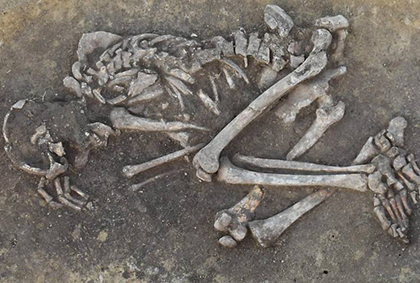
Within the framework of an interdisciplinary analysis of the Early Bronze Age burials from Drasenhofen, evidence was found for what are currently the oldest plague victims in Austria. The male individuals, who died at the age of 23–30 and 22–27 years, respectively, were buried not far from each other in the north-easternmost and south-easternmost grave of the row cemetery comprising a total of 22 graves. Despite the spatial and temporal proximity, the genetic pathogen analyses detected two different strains of plague bacteria (Yersinia pestis). Thus, it was not one infection that was transmitted within the Bronze Age group, but two independent infection events.
In this article, we present the phylogenetic positions of these two Yersinia pestis strains together with other prehistoric, historic and modern plague genomes known so far, discuss biological basics of transmission and possible transmission routes, and attempt a cultural-historical interpretation in comparison with similar anthropological and archaeological contexts.
https://austriaca.at/bronzezeit-pest-in-drasenhofen
Read media coverage below:
https://science.orf.at/stories/3219896/
https://www.derstandard.at/story/3000000175379/aelteste-pesttote-oesterreichs-gefunden