
New Paper by HEAS Member Tom Maltas
More On Article
- Reading All the Lines of Archaeological Legacy Records
- Early Gravettian genomic data from Western Europe reveal population movements before the LGM
- At the onset of the Late Gravettian: An updated chronology and stratigraphy for the multi-layered Gravettian open-air site Grub-Kranawetberg I (Austria).
- New Chronology Sheds Light on Human Occupation just before the onset of the Last Glacial Maximum
- Fire, temperature control, and silcrete heat treatment at Diepkloof and Mertenhof Rock Shelters, West Coast, South Africa
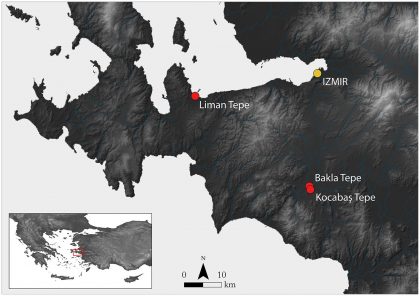
HEAS Member Tom Maltas has recently had a paper published in Scientific Reports on ‚Agricultural adaptations to mid-late Holocene climate change in western Türkiye‘.
Abstract
The period around the mid-late Holocene transition (c. 2200 bc) saw major societal developments across the eastern Mediterranean. At the same time, the region experienced a shift to more arid climatic conditions. This included punctuated episodes of rapid climate change such as the ‘4.2 ka event’, which has been implicated in widespread societal ‘collapse’ at the end of the Early Bronze Age. The ways in which societies adapted agricultural production to cope with a drying climate are poorly understood. We begin to rectify this through stable isotope analysis of archaeobotanical remains from the Aegean region of western Türkiye, conducted to reveal changes in agricultural decision making across the mid-late Holocene transition. We find that Bronze Age farmers adapted agricultural production strategies by investing in drought-tolerant cereals cultivated on drier fields with water management strategies redirected towards pulses. Despite this, we find no evidence for pronounced drought stress in cereals grown during the period of the 4.2 ka event. This raises the potential for alternative explanations for societal disruptions visible across the Anatolian Plateau during this time, such as the breakdown of long-distance trade networks.