Reading All the Lines of Archaeological Legacy Records
More On Article
- Early Gravettian genomic data from Western Europe reveal population movements before the LGM
- At the onset of the Late Gravettian: An updated chronology and stratigraphy for the multi-layered Gravettian open-air site Grub-Kranawetberg I (Austria).
- New Chronology Sheds Light on Human Occupation just before the onset of the Last Glacial Maximum
- Fire, temperature control, and silcrete heat treatment at Diepkloof and Mertenhof Rock Shelters, West Coast, South Africa
- Gerhard Weber and Harald Wilfing Retire
How can AI help specialists recover information from Roman pottery records? In this blog we introduce the LEGION project and explore how this technology can be applied across archaeology, from geoarchaeology to bioarchaeology.
Reading the archive
On a drawing sheet a few pencil lines describe the rim of a Roman vessel from the archaeological site of Carnuntum, one of Austria’s largest Roman sites and one of Europe’s largest archaeological landscapes. Since 2021, it has been part of the UNESCO World Heritage property “Frontiers of the Roman Empire – The Danube Limes (Western Segment)”. Beside the drawing are measurements, a find reference, and brief notes, including a crossed-out description. The sheet records both an ancient object and the work of the archaeologists who examined it. To read between the lines of a record, we first need to read all the lines – including annotations and corrections.
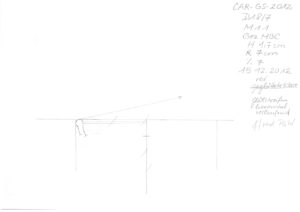
For someone familiar with these kinds of records, such a sheet may be straightforward to interpret. Comparing it with hundreds of similar sheets, however, takes considerably more work. A researcher might want to identify vessels with comparable rims, locate records from a particular excavation campaign, or trace the use of a ceramic term through the archive. Consequently, each question depends on finding and connecting details originally recorded for individual objects.
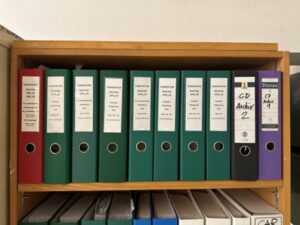
One example is the Carnuntum archive at the Austrian Archaeological Institute of the Austrian Academy of Sciences (OeAI/OeAW), which contains tens of thousands of pottery drawings from decades of research. Using this archive within LEGION (machine LEarninG-enabled Identification of archaeological Objects in the middle daNube river basin), we investigate how AI can make this accumulated knowledge available for new analyses. The project brings together archaeologists at OeAI/OeAW and researchers at TU Wien’s Computer Vision Lab (CVL), with funding from OeAW’s Heritage Science Austria 2.0 programme (project Heritage_2024-12_LEGION).
Testing the models
Much of the work begins with practical questions. Can a model distinguish a find number from a measurement? Can it read an abbreviation familiar to pottery specialists but rare in ordinary text? How does it handle a correction? A scan makes the sheet available on screen; answering these questions is necessary to turn its contents into information that can be searched and compared.
Our first published study introduces CENTURIA: 507 digitized pottery records with expert-validated transcriptions and structured annotations. We benchmarked five optical character recognition (OCR) models on handwritten text recognition (HTR), including vision–language models (VLMs) that read page images. Archaeological expertise was essential for resolving abbreviations, corrections, and uncertain readings.
Fine-tuning the two strongest models, olmOCR2 and LightOnOCR, on just 57 transcribed records substantially improved recognition. We paired scans with expert-checked transcriptions and used two training passes to adapt the models to the archive’s handwriting and terminology. Outputs were then organized into fields by matching predefined text patterns, such as find-number formats, or by using a language model. Overall field-extraction accuracy exceeded 87% on 450 held-out test records. Adaptation to other archives should be possible in principle, but performance with different handwriting and recording conventions still needs testing.
We were particularly pleased that the study by Gissu Valentina Naghavi, Dominik Hagmann, Martin Kampel, and Irene Ballester received the Best Paper Award at the Vision for Art and Culture workshop, held alongside ECCV 2026 in Malmö. The award recognises our interdisciplinary work connecting archaeological source criticism with the evaluation of computer vision methods.
Preserving the context
That connection also shapes the next steps. A technically convincing transcription still needs to be interpreted in context. On the pottery sheet in Figure 1, for example, the crossed-out wording is evidence of revision and must remain distinguishable from the other annotations. Keeping extracted information linked to the original scan allows researchers to check such decisions and revisit them when necessary.
As this work develops, we aim to connect the recovered information with the study of vessel shapes and archaeological contexts. This could make it easier to compare common ware across excavation campaigns and investigate how its use and distribution changed within Carnuntum. The publicly available CENTURIA dataset and code already allow others to test the methods. Revisiting existing records extends the research value of the detailed documentation created by earlier generations of archaeologists.
Looking beyond pottery
These efforts to make existing documentation useful for new research also have relevance beyond pottery. Geoarchaeological sample sheets, sediment descriptions, bioarchaeological skeletal inventories, recorded measurements, and burial documentation present related challenges: recovering information from heterogeneous records and connecting it to its context. Where identifiers permit, extracted entries could help link records of samples or human remains to excavation contexts and support comparative research. The same principles could also speed up digital capture of paper forms still used on current excavations, such as the type illustrated in Figure 4. Each of these possible uses would need to be evaluated in its own setting.
In this sense, AI would assist the respective domain experts, without replacing their expertise or judgement. Suitable reference data and specialist validation remain essential, including assessment of differences in terminology, recording conventions, and measurement protocols. Extracted information should remain traceable to the original documents, with recorded observations, revisions, and later harmonization clearly distinguished. Such adaptations could widen access to existing evidence while preserving the context that makes it scientifically usable. Reading all the lines can then help us make sense of what lies between them.