
A study by HEAS member Timo Canessa has just been published in the open access journal PLOS One.
More On Article
- At the onset of the Late Gravettian: An updated chronology and stratigraphy for the multi-layered Gravettian open-air site Grub-Kranawetberg I (Austria).
- New Chronology Sheds Light on Human Occupation just before the onset of the Last Glacial Maximum
- Fire, temperature control, and silcrete heat treatment at Diepkloof and Mertenhof Rock Shelters, West Coast, South Africa
- Gerhard Weber and Harald Wilfing Retire
- HEAS Workshop in New Methodologies and Perspectives in Palaeolithic Archaeofauna takes place in Vienna.
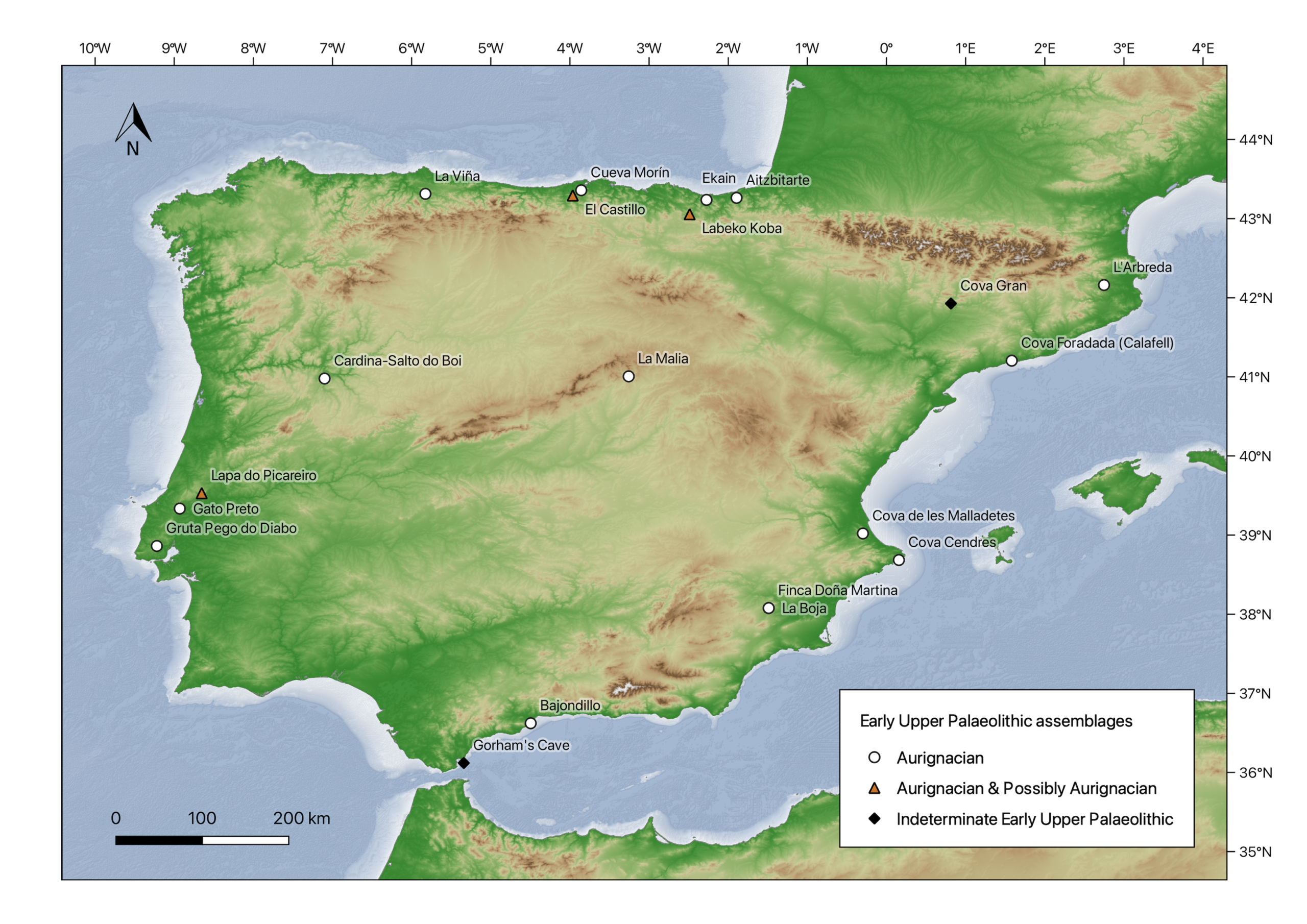
The Early Upper Palaeolithic of Iberia remains an actively debated record of human occupation, yet quantitative approaches to lithic assemblage variability are still lacking, especially among large-scale datasets that span the entire period and region. In this study, we utilised a newly compiled dataset of Aurignacian assemblages to explore techno-typological variability and test its spatial and temporal dimensions. Our work has been able to show that variability has a spatial – rather than temporal – character to the effect that assemblage dissimilarities increase with spatial distance. Our findings thus challenge the application of the classic Aquitaine model of techno-typological change and suggest that temporal change in the Aurignacian may be more unstructured than otherwise deemed. This has wider implications for the detection and characterisation of the technocomplex at large, corroborating previous claims of mosaicism and an inconsistent representation of diagnostic traits.