Designing with the Past: Archaeologists and Fashion Students in Creative Dialogue
More On Article
- Fire, temperature control, and silcrete heat treatment at Diepkloof and Mertenhof Rock Shelters, West Coast, South Africa
- Gerhard Weber and Harald Wilfing Retire
- HEAS Workshop in New Methodologies and Perspectives in Palaeolithic Archaeofauna takes place in Vienna.
- The gene-regulatory evolution of the human skeleton
- Demographic history and management practices shape the genomic landscape of New Zealand’s feral Kaimanawa Horses.
By: Karina Grömer and Christina Dörfler
What can a 2,700-year-old textile fragment from the salt mine Hallstatt or a bronze belt decorated in “Situla-Style” tell a fashion designer? More than one might expect. At the Natural History Museum Vienna (NHM), archaeological textiles, jewellery, and reconstructed garments are no longer confined to museum showcases and archives. Through an innovative collaboration with the Vienna design school KunstModeDesign Herbststraße, prehistoric clothing has become a source of inspiration for contemporary design, demonstrating that archaeology is not only about preserving the past—it can also help shape the future.
The project „Hallstatt Revisited – From Archaeological Research to Contemporary Design“ (2025/26) was conceived as an interdisciplinary dialogue between archaeology, fashion, craftsmanship, and sustainability. Rather than copying prehistoric costumes, design students were encouraged to understand the ideas behind them: the technologies, materials, aesthetics, and cultural meanings that shaped textile and jewellery production during the Bronze and Iron Ages in Europe. These insights then served as the foundation for entirely new artistic creations rooted in scientific evidence.
Archaeology as a Design Laboratory
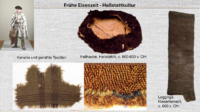
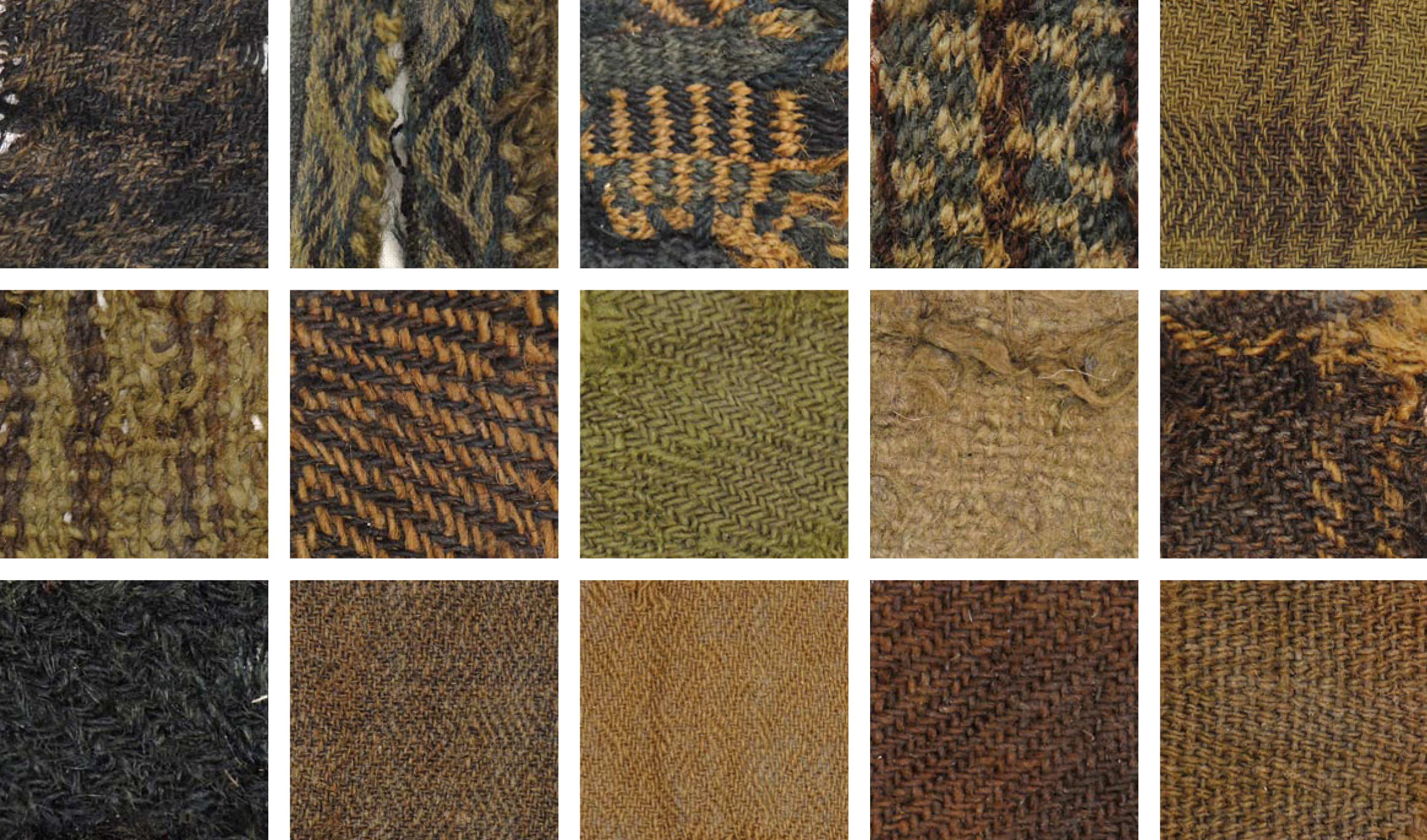
The Hallstatt salt mine in Austria is internationally renowned for preserving one of Europe’s richest collections of prehistoric textiles (Fig. 1). Thanks to the exceptional conservation conditions created by rock salt, more than 700 textile fragments dating between approximately 1400 and 400 BCE have survived. These fabrics reveal sophisticated weaving techniques, colourful patterns including stripes and checks, decorative seams, tablet weaving, and evidence of repair and reuse—offering a remarkably detailed picture of prehistoric craftsmanship and resource management.
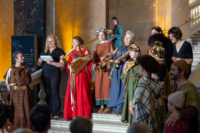
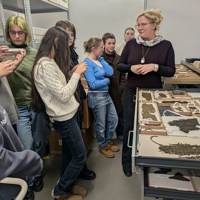
For archaeologists, these textiles answer questions about technology, economy, and identity. For fashion students, they provide an unexpected design archive. The collaboration therefore began not in a classroom but in the museum collections. Students visited the archaeological storage facilities, examined original artefacts, handled replicas, and even wore reconstructed prehistoric garments (Fig. 2 and 3). This direct encounter with archaeological evidence allowed them to experience ancient clothing not simply as historical objects but as wearable, functional designs.
The project deliberately encouraged close observation. Students sketched artefacts, photographed details, discussed construction methods with archaeologists, and explored questions that remain highly relevant today: How were garments produced? Which materials were locally available? How were objects repaired instead of discarded? What can prehistoric societies teach us about responsible use of resources?

Learning Through Making
A central element of the collaboration was the combination of scientific research with practical experimentation. Workshops introduced students to the principles of textile archaeology, prehistoric clothing, spinning, weaving, and ancient craft techniques. Rather than treating archaeological finds as static museum objects, participants explored them as products of human creativity and technical knowledge.
This „learning through making“ approach reflects one of archaeology’s most powerful educational methods. Reconstructing garments and technologies provides insights that cannot be gained through excavation alone or classical typological studies. Wearing reconstructed costumes reveals how clothing influences posture, movement, and social interaction, while reproducing textile techniques offers a deeper appreciation of the skill and time invested in prehistoric craftsmanship.
At the same time, students were encouraged to reinterpret rather than reproduce archaeological evidence. The objective was not historical accuracy in fashion design, but creative transformation informed by research.
Ancient Inspiration, Contemporary Messages
The resulting designs illustrate how archaeological heritage can inspire modern artistic expression while addressing current social issues.
One of the 25 designs, TWIST AND SWORD (Fig. 4), reinterpreted Hallstatt swords—traditionally symbols of elite warriors—as expressions of female empowerment. Inspired by prehistoric clothing silhouettes, the designers combined a peplos-like dress with a naturally dyed wrap skirt featuring screen-printed dagger motifs. Contemporary jewellery transformed miniature swords into wearable symbols of strength and identity.
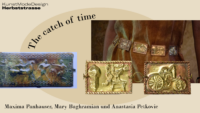
Another design, THE CATCH OF TIME (Fig. 5), combined experimentally dyed textiles with handcrafted brass jewellery inspired by prehistoric repoussé and chasing techniques known from Iron Age Situla Art. Here, ancient metalworking traditions became a visual language for reflecting technological and social change across time.
These examples demonstrate that archaeology does not dictate design. Instead, it provides stories, techniques, forms, and materials that designers can reinterpret within contemporary cultural contexts.

Sustainability Has Deep Roots
Perhaps the most striking aspect of the collaboration is its emphasis on sustainability. While sustainability is often discussed as a modern challenge, archaeological textiles remind us that careful resource management has deep historical roots.
Hallstatt textiles preserve numerous traces of repair, recycling, and efficient use of raw materials. Wool was processed with remarkable precision, fabrics were maintained over long periods, and every stage of production required significant investment of labour. Understanding these ancient production systems encourages reflection on today’s fast-fashion industry and its environmental consequences.
This perspective aligned perfectly with the educational philosophy of KunstModeDesign Herbststraße, whose previous award-winning projects have focused on anti-fast-fashion initiatives and sustainable design. Within Hallstatt Revisited, prehistoric craftsmanship became not merely a historical subject but a catalyst for developing environmentally conscious design strategies.
Science Meets the Catwalk
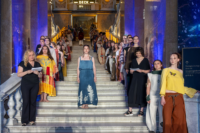
The collaboration culminated in a public fashion event at the Natural History Museum Vienna on the 19th June 2026 titled „Catwalk from the Past to the Future“ (Fig. 6). Rather than presenting fashion and science separately, the event integrated both. Approximately fifty reconstructed prehistoric costumes—from the Stone Age to the Early Middle Ages—were presented alongside contemporary student collections inspired by archaeological research. Scientific explanations (Fig. 7) accompanied the runway presentations, allowing visitors to understand the archaeological evidence behind each reconstruction and the creative processes behind the new designs.
The fashion show demonstrated how museums can become spaces for dialogue rather than repositories of the past. Archaeological research reached audiences through visual storytelling, performance, and design, while design students discovered that history offers far more than decorative motifs—it provides ideas about craftsmanship, identity, innovation, and sustainability that remain remarkably relevant.
As museums increasingly seek new ways to communicate research, projects such as Hallstatt Revisited illustrate the potential of interdisciplinary collaboration. By bringing together archaeologists, designers, artists, and educators, the prehistoric textiles and jewellery are transformed from silent artefacts into active participants in contemporary cultural conversations.
In this sense, the distance between an Iron Age salt mine and a modern fashion runway (Fig. 8) is not measured in millennia, but in imagination.