
A study by HEAS member Timo Canessa has just been published in the open access journal PLOS One.
More On Article
- Unpacking lithic assemblage variability in the Early Upper Palaeolithic: A multivariate approach to the structure of the Iberian Aurignacian
- FWF funding for open-access publication Methodological Innovations in pXRF Studies
- Up and down the hill: Hillforts and dry stone wall enclosures on the Kvarner Islands of Cres and Lošinj in remote sensing data
- A microcontextual investigation of Later Stone Age ash deposits and associated interment of human remains at Faraoskop Rock Shelter, South Africa
- 35 Jahre “Archäologie Österreichs”. Ein Rück-und Ausblick auf die Wissensvermittlung durch Printmedien der ÖGUF.
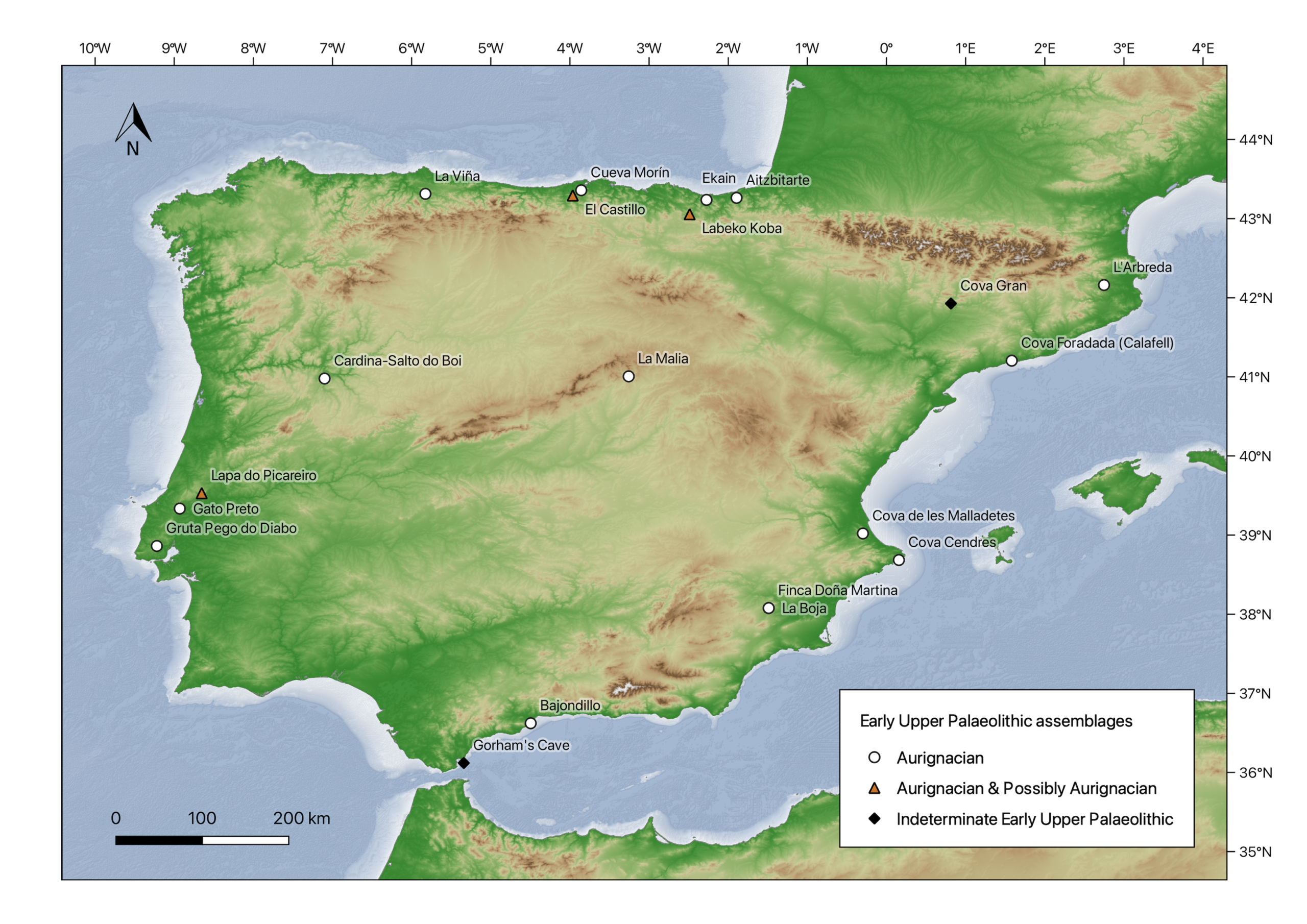
The Early Upper Palaeolithic of Iberia remains an actively debated record of human occupation, yet quantitative approaches to lithic assemblage variability are still lacking, especially among large-scale datasets that span the entire period and region. In this study, we utilised a newly compiled dataset of Aurignacian assemblages to explore techno-typological variability and test its spatial and temporal dimensions. Our work has been able to show that variability has a spatial – rather than temporal – character to the effect that assemblage dissimilarities increase with spatial distance. Our findings thus challenge the application of the classic Aquitaine model of techno-typological change and suggest that temporal change in the Aurignacian may be more unstructured than otherwise deemed. This has wider implications for the detection and characterisation of the technocomplex at large, corroborating previous claims of mosaicism and an inconsistent representation of diagnostic traits.