First Austrian-led expedition presents finds from the „Cradle of Humankind“
More On Article
- At the onset of the Late Gravettian: An updated chronology and stratigraphy for the multi-layered Gravettian open-air site Grub-Kranawetberg I (Austria).
- New Chronology Sheds Light on Human Occupation just before the onset of the Last Glacial Maximum
- Fire, temperature control, and silcrete heat treatment at Diepkloof and Mertenhof Rock Shelters, West Coast, South Africa
- Gerhard Weber and Harald Wilfing Retire
- HEAS Workshop in New Methodologies and Perspectives in Palaeolithic Archaeofauna takes place in Vienna.
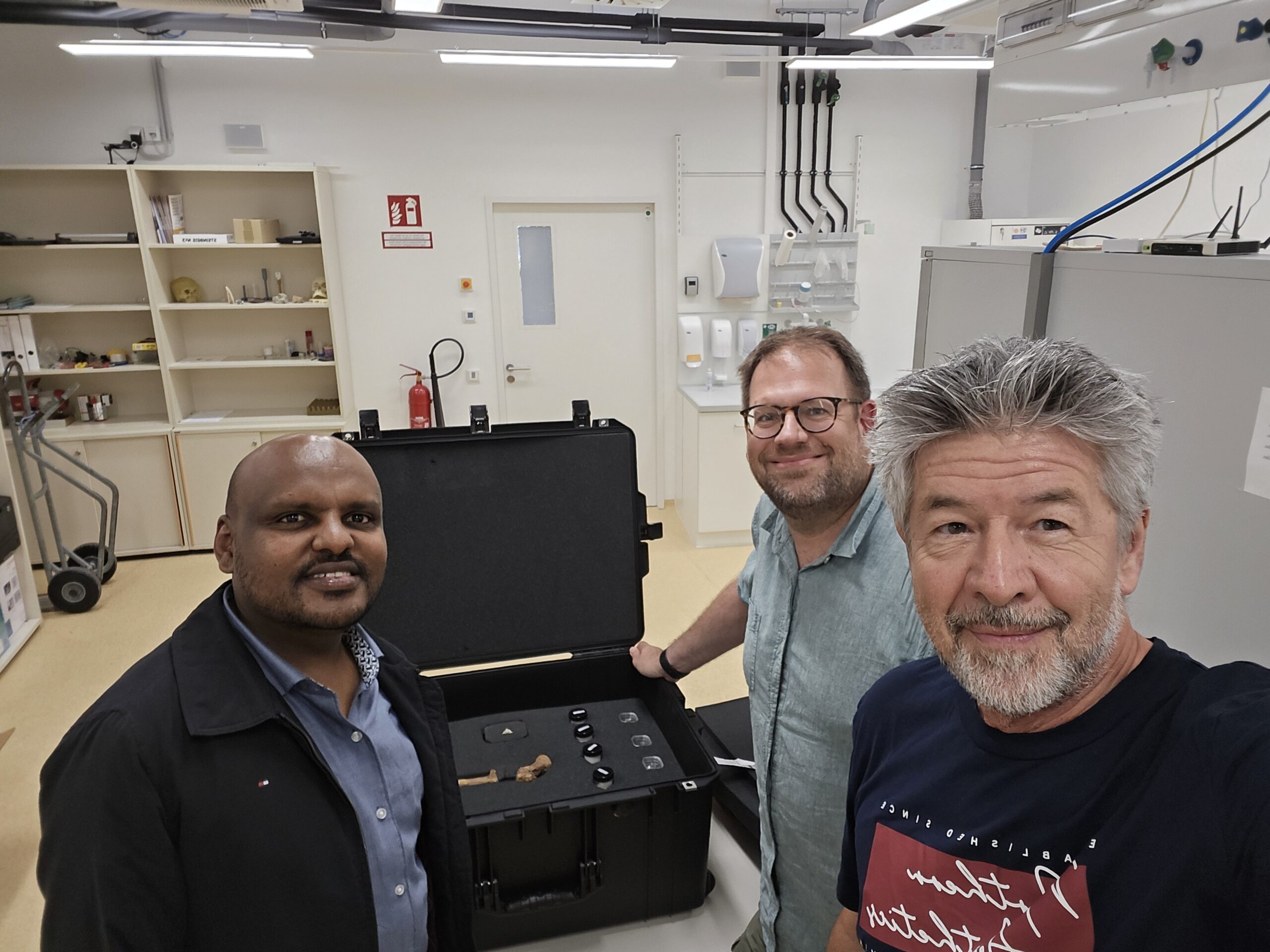
The fossils found from Ethiopia are in Vienna for the first time for examination at the Department of Evolutionary Anthropology at the University of Vienna.
An interdisciplinary and international research team led by the Department of Evolutionary Anthropology at the University of Vienna was on the road in the Somali region in eastern Ethiopia in the years 2000-2009 to search for the ancestors of mankind. For the first time in the history of Austria, it has been possible to make some finds of australopithecines and even earlier hominins. These date back to a time of over 5 million to 3 million years ago. Now an export permit has finally been obtained in order to be able to examine the finds in Vienna using state-of-the-art methods.
It is particularly interesting that the fossils all come from a locally narrowly defined area of less than 100 km2, but cover exactly the period in which our first truly identifiable precursors, the australopithecines, developed. Such sites from the early Pliocene are very rare and it is hoped that the detailed examination of the finds will provide further information about the beginnings of the incarnation. The project was initiated in 2000 by the anthropologist Univ. Prof. Horst Seidler and continued for ten years.
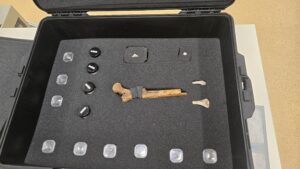
In the desert-like sediments around Mount Galili/Ethiopia, 10 different teeth were found under extremely harsh conditions during the excavation campaigns, a well-preserved part of a thigh, a part of a child’s upper arm, and a metatarsal bone. Although teeth seem rather inconspicuous to the layman, they can tell a lot about their former owner, such as ancestry and nutrition. It is hoped that the thigh bone will teach us more about the beginnings of bipedalism, which developed during this time. In cooperation with Harvard University and the Helmholtz Centre for Georesearch in Potsdam, isotope analyses are also to be carried out to provide information on climate and food.
In order to get the maximum amount of information out of the fossils, it was important to get them to Vienna, where they can be recorded in detail with the help of micro-computed tomography in the Vienna Micro-CT Lab of the University of Vienna. The Ethiopian curator Sahleselasie Melaku Azene has travelled to Vienna especially for this purpose and supervises the analysis processes. Colleagues from the University of Toronto and the Senckenberg Research Institute Frankfurt have also come to Vienna. Photo documentation and scanning will continue throughout the week before the fossils return to Addis Ababa at the end of the week.
Scientific Contact in ViennaUniv.-Prof. Dr. Gerhard Weber, Department of Evolutionary Anthropology, HEAS – Human Evolution and Archaeological Sciences, University of Vienna, gerhard.weber@univie.ac.at
Univ.-Prof. Dr. Bence Viola, Universität Toronto, bence.viola@utoronto.ca
Univ.-Prof. Dr. Ottmar Kullmer, Senckenberg Research Institute Frankfurt, ottmar.kullmer@senckenberg.de
Read More
https://science.apa.at/power-search/8272642850369364716
https://science.orf.at/stories/3236095/
https://oe1.orf.at/player/20260622/835494/1782125379300
https://orf.at/av/video/onDemandVideoNews86000